Friday, October 28, 2011

Diwali, as it happened

I've been talking too much. Here are some pictures of Diwali. First, lights, and I should mention that all the photos that look good were taken by Gaurav, a quite skilled photographer:

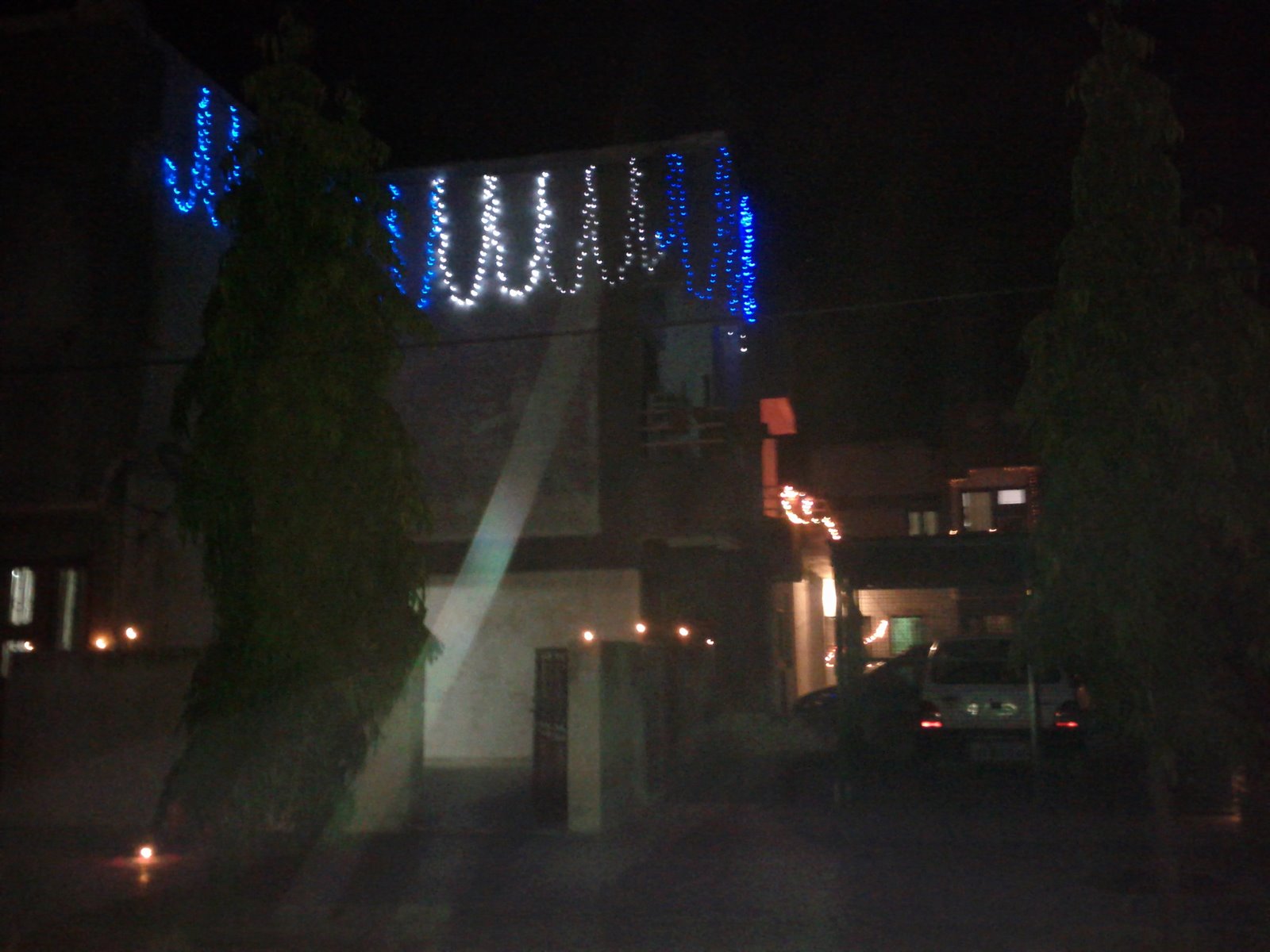
Lighting the diyas (mini oil lamps) around the house and balcony

Some lights around the neighborhood


Next, fireworks:


Gaurav insisted on getting this photo. Expecto patronus!

Friends:
A bunch of neighbors. Hemant on the right.

Me and Gaurav, as I was leaving.

I meant to get a photo of us all, but Hemant and his mother were napping as we left. I'll be back in December. Now I'm in pleasant vacation town Nainital, and getting here was a bit of an adventure, including successfully running to catch a train, almost getting invited to someone's party, listening to music because I was just too worn out from socializing, and sleeping in the nut low of hotels in Haldwani. But I'm here, no worries, and will hang out today before heading to my friend Victoria's school tomorrow!

Tuesday, October 25, 2011

Happy Diwali!

Especially to my Indian friends: hope you have a great Diwali, and that Lakshmi visits while you are awake!

I'm at the Gurgaon home of my friends Hemant, Gaurav, and their mother Ama. They are the kindest kindest hosts; my every need or want is answered, and then some, and the only chore I've been allowed to help with is making wicks for the diyas, the ceremonial Diwali oil lamps. Plus, cooking lessons: Ama (an excellent cook) has been teaching me paranthas and chapatis, and I keep nosing my way into the kitchen to find out more.

Anyway, Diwali, the Festival of Lights. Way back when, the god Rama's wife Sita was stolen by the demon Ravanna, who took her to south India. So Rama came down and trashed Ravanna, creating the festival of Dussehra, which happened 20 days ago. Then he returned home to Ayodhya in north India 20 days later, creating Diwali. Also, Lakshmi, goddess of wealth and prosperity, got into this holiday somehow: she's supposed to visit during the day, so don't sleep too much, because you might miss her.  You light the diyas oil lamps, you put christmas lights on your house, you shoot off fireworks in the street, you go to puja (prayer ceremony) at the temple. Two days before Diwali is Dhanteras, a popular day to buy things. Also you're supposed to clean your house thoroughly, and trade in your old dishes for new ones, and hoo boy, now that I wikipedia it, it turns out there are a lot of different reasons and customs for Diwali.

Photos and more descriptions to follow!

Sunday, October 23, 2011

Stay at an ashram: check

Do some yoga: check
Bathe in the Ganges: check
Sing Hare Krishna: check (well, technically we've been singing other chants here, but I sang Hare Krishna at Bhojbasa. check.)
Chill the heck out and catch up on internets: also check.

The last couple of days have been nice. I've been at the Santosh Puri Ashram near Haridwar. What's an ashram? I'm not sure, but it seems to be a temple, guesthouse, and yoga school rolled into one. This one has meals, yoga classes (hatha, pranayama, and ashtanga have happened since I've been here), and daily aarti/puja/prayer ceremonies. It's run by a lady sadhu (holy person) named Mata-ji, and she and the rest of the staff are super friendly and great.

The place looks like this:


And I've gotten a chance to explore Haridwar a bit. It's been called the Indian Rishikesh, or rather that Rishikesh is the foreigners' Haridwar. It's on the Ganges, people like to take baths, and it's holy. (the Kumbh Mela was here last year! I met someone who went!) It's also crowded and dusty. But it has some interesting things, including the Mansa Devi temple on a hill (it's really a temple complex, with bookstores, cafes, and big cage walls around so you don't fall out), a big statue of Shiva, and a couple of great lassi/kulfi shops. Ask someone for recommendations.


Saturday, October 22, 2011

Bed hard, knees hurt, I'm done!

So I did a 10-day Buddhist Vipassana meditation class led by S. N. Goenka.

Vipassana means something like "insight." It's a word often used in the Theravada tradition (though it's in Mahayana too). Theravada is kinda the South Asian kind of Buddhism, as opposed to the Tibetan Mahayana/Vajrayana kind or Japanese/Chinese Zen or other Mahayana traditions. Vipassana meditation aims to develop not only concentration, but also fundamental wisdom: the knowledge at the deepest level that all things are impermanent and only exist dependent on other things.

S. N. Goenka is a very successful Vipassana teacher. He's started a bunch of meditation centers around the world with a standard 10-day program to introduce people to Vipassana meditation. He's from Burma, and got popular in India.

How was the retreat? In a word: tough.

I've posted the daily schedule before. Here's how it actually worked:
  • 4 AM: wake up gong and guy walking around with bell. My roommate Nick turns on the light so the bell guy thinks we're awake and doesn't pound on our door.
  • 4:20 AM: second wake up gong, actually wake up and trudge to meditation hall
  • 4:30 AM: meditation
  • 5:45 AM: Goenka starts chanting. After about day 3 I learned to leave the meditation hall at about 5:30 and go back to sleep some more.
  • 6:30 AM: breakfast and go back and sleep more
  • 8 AM: meditation
  • 9 AM: meditation
  • 11 AM: lunch and go back and sleep more
  • 1 PM: meditation
  • 2:30 PM: meditation
  • 4 PM: meditation
  • 5 PM: tea and snacks
  • 6 PM: meditation
  • 7 PM: dhamma talk
  • 8:30 PM: meditation
  • 9 PM: ask the teacher questions or go sleep
How did I survive?
Physically: they weren't sticklers about posture, for the most part. (not that it would matter if they were; there's only so much my body can do.) Still, there was a lot of knee and back pain. Work with it; it's a sensation like anything else...

Mentally: it was exhausting! Just concentrating for all that time. And the knowledge that it would be 10 days long; days 6 and 7 were tough. I was kinda wiped by about day 8 or 9 and tuned out a bit.

The food: simple but mostly good. Breakfast was fruit, bean sprouts, some grain dish (porridge, cornmeal, idlis), milk, and tea. Lunch was curd, rice, dal, chapati, and a vegetable dish. Tea was served with fruit and rice krispies. I think it's true that eating less helps you meditate better. Or at least concentrate.
I unfortunately discovered, I think, bitter melon, and now there might be an Indian food I don't like. Well, give it time.

The center: pretty! In the woods, half hour outside Dehradun.


The lodging: Simple concrete room with attached bath.
Basic but good. Except:

The spiders: Big old dudes! Usually about 2-3" wingspan, most with small bodies. I got used to them surprisingly quickly. There were a couple fat dudes, and they still make my blood run cold. But every room was equipped with two spiders. Ours only came out at night, and they hung out in the bathroom (thank god). Sometimes we would kill them, but they would come back the next day. Reincarnation!

The meditation hall: nice enough. Big room.
Two spiders in the supply room. I did 90% of my meditation here; a couple times I escaped to my room to meditate, and once I tried the pagoda. The pagoda is a building full of tiny meditation cells. Nothing in each room but a cushion. Really rather nice. But I never went back after the first time; my cell had two spiders.

The actual content of the class: It was pretty good. First you learn Anapana meditation, which involves just concentrating on your breath. Then you learn Vipassana meditation, which (in Goenka's method) involves scanning your body, becoming aware of physical sensations, and developing equanimity towards them. Don't react, don't say "this sensation is good and this one is bad", just observe it and note that it's impermanent and is not you. I've blogged more about it on my other blog, if you're interested in all the Buddhism and philosophy and stuff.

The odd thing was that all the dhamma talks and instructions before/after each meditation session were done by Goenka himself, by video and audio tape. It felt a little like a meditation factory; you come here, you do the technique, no quibbling, no questions. Well, you could ask questions, but they were answered by an assistant teacher who was not awesome at answering questions. As it was a beginners' class, that was mostly fine, except:

Goenka chanting. This guy has a voice like a Gregorian monk getting slowly run over by a gravel truck. When they turned on the tape for the first time, and "buh-duh-guh-duh-buh-guuuuhhhhhhhh" blared over the speakers, my first thought was that the speed was too low. My second thought was that we were listening to a guy die. And they played this not only for five minutes at the beginning/end of each class, but also for friggin' 45 minutes each morning. AND over a loudspeaker while we're trying to nap after breakfast. Mr. Goenka, if complete silence is important to develop deep concentration, why are we listening to you chant some incomprehensible Pali every day? Which reminds me:

Noble Silence: as in previous retreats, we weren't supposed to talk (incl sign language etc) for the first 9 days. This is actually not very hard. But it was really great on the 10th day when we got to talk, and actually meet some of our fellow meditators whom we've been seeing for a week and a half! Here are some of them:

Overall: No fireworks, but I'm glad I've done it. I feel pretty good now. And I'm sure it's helped my meditation practice.

Monday, October 10, 2011

Signing off now...

Right, well, I'm going to do this retreat thing now. Again, it's at the Dhamma Salila Vipassana center in Dehradun, the website is dhamma.org, if you're interested.

About equal parts excited and worried. Well, with some curiosity too, because as far as I know I can't meditate for more than a couple hours per day, so how will I adjust to meditating for very many hours a day? I guess we will see!

No blogging, email, or phone during the retreat, so I'll see you in 10 days! Y'know, unless I levitate into the air, shoot rays of light out of my head, and vanish into a puff of Nirvana.

Sunday, October 9, 2011

I am so done with 12+ hour bus days


... at least until Nepal. Eesh. I've made it to Rishikesh and found a very adequate hotel room. I plan to sleep a lot and clean up a bit. (freezing cold and tired -> no showers or laundry in Gangotri.) Catching up on internet before I go off the grid again.

There are high and low points to travel, particularly solo travel, and yesterday was not a high point. It's eased a bit by the fact that the next few weeks will likely be easier, in terms of amount of traveling.

I'm in Rishikesh now. It seems pleasant enough. Definitely Indian, with all the honking and heat, and definitely a tourist spot, with all the laundry, wi-fi, and German Bakeries. I'm getting old and cranky, as I'm gladder that it's a tourist spot than that it's an Indian spot. (or I've just been traveling too much).

There are two nice foot bridges over the Ganges. Here you can see one.

Thursday, October 6, 2011

Bringing the "pilgrimages for religions I don't really believe in" count to 3


Trek from Gangotri to Gaumukh completed! ("Hike" to Americans; not talking about Klingons here, despite some of these names)

What is it: Gangotri is a town with an important Hindu temple. It's one of the Char Dham pilgrimage sites. I guess it's kind of holy. Gaumukh is the glacier that feeds the Ganges. I guess it's kind of holy too. The trek between them is pretty easy and very pretty.

Description: so it's 18km each way (11.2mi), and the elevation goes from 3400-4255m (11200-13900ft). The first 9 km is an easy walk. Next 5 km is a harder walk. Most people (incl I) stop overnight at the 14km mark, at Bhojbasa. The 4km from Bhojbasa to Gaumukh is mostly easy, but the last 1km is clambering over rocks.

Some pictures so you can see what I'm talking about:
Evening puja at Gangotri temple the night before starting the walk


There were only a couple of shaky log bridges.


(those couple tents and buildings are Bhojbasa)


That's the glacier. It's actually rather smaller than I'd imagine, or at least, what we could see was rather small. I guess it's receded literally kilometers in the last century. I don't know what this means, but it can't be good.


(this might be a good time to mention I take slightly more photos than I blog. They're all up at my picasa site.)

What's foremost in my mind after this trek:
- This might be the first time I've liked hiking better than camping. Usually the hiking is kind of a necessary evil and camping is fun. But this time, the trail was easy and I was really just enjoying walking. Plus:

- Bhojbasa was so cold! It was The Coldest! From about 2pm on, it was nonstop coldsville! I wore all my clothes, climbed under a heavy blanket at 6pm and hardly emerged until sunrise, and still ended up huddled around the cook's kerosene stove trying to keep my hands warm. I slept about half the night, and spent the rest of the night wishing time would pass more quickly, and wondering if I should check what time it is or not. (on the plus side, though, this frozen night did provide one of the most vivid lucid dreams I've ever had.)

- Don't wear barefoot-style walking shoes on a 22-mile mountain trek. Why would you do that.

- I've kinda gone it alone on this Gangotri trip. I mean, I'm friendly and talking with folks, but I was really enjoying hiking by myself. Of course, some of each is good.

- The type of challenge on this trip has been really energizing. Something about the combined cultural, social, and physical challenges has kept me thinking "wake up, you have great things to do!" Everything is novel; every experience is something I want to write down or photograph. I must figure out some way to get this sort of challenge into my everyday life when I settle down again.

- I wear a beanie now. Beanies are cool.