Friday, November 25, 2011

Orange Picko

(My current couple days: Darjeeling->Kalimpong->New Jalpaiguri (now)->Kolkata (overnight train). I'll get back to the photos soon enough, but I haven't been able to connect my computer to some fast internet.)

Travel is full of so many absolutely perfect moments. Not in that they're super fun or exciting or feel-good, but in that they feel like scenes from a particularly well-directed movie.

So I'm in Darjeeling, and Darjeeling tea, right? so I'm going to visit a tea plantation. The closest one to town seems to be "Happy Valley Tea Plantation" so I follow the road until I think I find it, walk down an unofficial-looking path, and meet an unofficial-looking oldish Indian lady. She asks if I'm here to learn about tea. Well, sure, I guess. I walk with her and her young daughters to her house. I ask how old her daughters are, just to make conversation, and she says "14. Too young." which makes no sense because there are two of them, the older one is eight years old, tops, and too young for what? This gives you an idea of how much language barrier we're dealing with.

She sits me down in a room filled with antique furniture, stuffed animals, and my god wall to wall kitsch. I think she doesn't know Precious Moments dolls exist, because if she did, there'd be an infestation. She sets out some dry loose teas and gives her little sales pitch. This is not without some charm: lines like "What makes Happy Valley tea the best? It's the Happy." are delivered with a little gleam in her eye, like she really believes it. It's quite cute, really.

After a while, she goes into the specifics of Darjeeling tea, which is really what I'm there for. With some relish, she explains the beloved SFTGFOP1 acronym, starting with a singsong recitation: "Super fine tippy golden flowery orange pekoe, number 1!" and continuing: "S is for super, because it's picked in the first time of the year." False, this term is "first flush." "F is for flowering, because the tea flower is in there also." False, I think. Wait, where did "fine" go? "T for tippy!" pointing to the tip of the leaf. "G is for golden, because the tea is golden." Maybe. "F for flowering," (again) "and O for orange, because the tea is orange." False; check wikipedia if you're interested. "and P for picko. Because we're picking the leaves!" I don't even know what "pekoe" means, but it's not that.

At this point, three Argentinian backpackers walk in. She directs them to seats, motioning one to a chair that's already occupied by a giant pink teddy bear: "You sit there, with Pinky." They just want to drink a cup of famous Darjeeling tea. After finding out that she's charging fifty entire rupees ($1) for the tea and the lesson, and looking askance at me sipping said tea, they mumble among themselves, make some noise about how that's too expensive, and walk out.

There's an uncomfortable silence, because these cheap bastards just walked out on one of those experiences that you don't walk out on for a damn dollar. Sure, she was selling us something, but she invited us into her home, and you're going to get a good cup of tea, and I mean you got to sit with Pinky-- anyway, she and I sit looking not at each other, sort of avoiding eye contact, and then she turns to me with a sad smile and delivers the line that made my whole week:

"You know, they just don't know quality."

Tuesday, November 22, 2011

About Gross National Happiness

Bhutan famously has a policy of "Gross National Happiness", meaning that they aim to maximize happiness instead of profit/GDP. How well does this work?

Well, right now, it's pretty good. Bhutan seems to be doing well. They have low (nonexistent) crime, 100% hydro power, low pollution, pretty good education I think. Tourism is pulling in some decent money, but it's not swallowing their culture. I asked a couple Bhutanese folks "what are the big problems you see facing Bhutan?" and they said "well, the roads are not very good."

But then, they only have 700,000 people. It's easy to avoid all the problems that come from too many people when you don't have too many people.

Some of the policies they've implemented are promising: the sustainable and clean hydro power, the cultural survival (folks still wear the national gho/kira clothing widely, buildings look good), the resistance of tobacco (sale is allowed but highly taxed, smoking in public is officially prohibited). Some of the policies seem immature: they don't have any slaughterhouses in the country, so they import their meat. It's on the way to sustainable vegetarianism, I guess, but it's kind of a weak philosophical dodge. And some of their problems are probably just hidden from me. I read Beyond the Sky and the Earth, in which the author describes her life in a rural Bhutanese village, and it's worlds away from Thimphu: tapeworm and giardia, clashes with ethnic Nepalese and widespread sexism.

So I guess (in my humble expert political opinion) I'd look at Bhutan the same way I'd look at a startup with a motto of "Don't be evil": it's untested and not guaranteed, but has as good a chance as any to succeed.

Sunday, November 20, 2011

Bhutanese Food


Bhutan's mountainous, so their food is meaty. There are potatoes and cheese too. But the distinctive part is the chilies. There are chilies in everything. They're not super spicy, as hot peppers go, but they're ubiquitous. Their most famous dish, Ema Datsi, is just chilies in cheese. I've had meals of ema datsi, beef with chilies and cheese, pork with radish and chilies, soup with chilies, and pickled chili paste on the side.

If that sounds terrible, never fear, and if that sounds great, read on. The trick about Bhutanese food is that you won't get any by default. For each meal, you're herded into the tourist room, and all you white people are served a sumptuous buffet of vaguely-Asian dishes. Stir fried vegetables, some beef or chicken, noodles, maybe fried rice or momos. Meanwhile, your guide and driver are in the other room, eating their everyday (delicious) Bhutanese food! I guess they figure that tourists will want the more familiar stuff. So the secret is, if you want Bhutanese food, ask your guide if you can eat with them. It's an unusual request, I guess, so be very clear ("yes, I actually do want to eat Bhutanese food, like the kind you're eating, and yes, I like spicy food"), and they'll let you. It's more fun too, especially if you're alone. Eating alone in an empty room is weird.

Anyway, more about the food: they sometimes drink butter tea, like the Tibetans, and sometimes buttermilk (whey). They eat a lot of red rice, which is short grain and only a little sticky. They use the whole animal: dishes like pigs' feet show up sometimes. Dried meat and dried fish are popular as well. And they eat a lot. "We Bhutanese are good in eating! Not so good in working," laughed one guide. I have to disagree about the working, but it's true that I often found myself quite stuffed.

Bhutan part 2: more than just gurus and flying tigers


After my five days in Bhutan, I was as exhausted as my bank account. Sightseeing in the mornings, traveling in the afternoons, and then whatever we wished in the evenings.

First, the sightseeing: alternately awesome and kind of boring. As usual. I always forget this about traveling, but sightseeing is great if you're already interested in what you're seeing, but if not, you may spend time trying to convince yourself that you're interested in things, which is a bit painful. Nevertheless, I'm glad we did all that sightseeing, because if I'm in Bhutan for 120 hours, I want to see as much as possible, and some sites ended up being unexpectedly cool.

For example: the National Library (shelves and shelves of Buddhist prayer scrolls, and the world's biggest book), the Takin Sanctuary (odd looking beasts), Chhimi Lakhang (fertility temple, with strange blessings, more on that later), and the 108 Chortens (cool atmosphere, especially in the fog).
The world's biggest book is just called "Bhutan".

According to legend, "Divine Madman" Drukpa Kunley ate a goat and a cow, and then stuck the goat's head on the cow's body, creating the Takin.

I guess Chorten is a synonym for Stupa. This is the Bhutanese style.

Some other sites we saw: Drukgyel Dzong, the National Memorial Chorten, a big Buddha on a hill, Kyichu Lakhang, and the huge Punakha Dzong.
Punakha: former capital of Bhutan! The Bhutanese royal wedding happened there just last month!


Second, traveling: longer than it seems. We drove only about 3 hours per day, but as Bhutan is all valleys connected by mountain passes, it's mostly winding mountain roads. And I guess driving at night is rather unsafe, so we arrived at the next day's destination every day at around 3.

Thought About Bhutan Tourism #1: their tourism industry is geared for old people and group tours. I guess if you sightsee in the morning, drive until 3:00, then you're done for the day. But it left us time for...

Third, the evenings: so, I don't know what to do in the evening in Bhutan. Hell, I don't know what to do in the evening anywhere. Especially if there's someone else trying to make sure that I'm having a good time. I mean, I like to walk around cities, and I like to read books. Luckily, RK (my guide) knows people everywhere. In Paro we played snooker; in Punakha we played snooker, had some drinks, and went dancing until the club closed at midnight; and in Phuentsholing we celebrated his cousin's birthday (including some snooker).

Which brings me to Thought About Bhutan Tourism #2: their tourism industry is geared for old people, but it's actually a great place for young people to travel (... if you can afford it). Your guide will probably be a young guy, so you'll be able to relate a bit. And if he's as cool as RK, he may welcome you into his social life for a few days. I met a few of his friends, lost a lot of snooker, had some good conversations, and (of course) will remember them much longer than I remember the chortens and dzongs.

Finally, a couple more photos of interest:


To quote RK, "Well, there's a lot of dicks there." I guess Drukpa Kunley's symbol is, well, a dick, so people paint them on their houses to invoke his protection.

We stayed one night at a hotel at Dochula pass. Awesome views. (but 10,000 ft, and I got a little altitude-sick.)
Almost forgot about the plane ride from Kathmandu to Paro. Not too often can you look out your window and see Himalayas. (and our propeller, which apparently works by hurling boomerangs at the ground. camera tricks!)

Tuesday, November 15, 2011

Bhutan part 1, or, I could call you from India for an entire day and I'd still spend less than I am spending here but I think it's worth it


Bhutan costs $240/day. $200 plus $40 extra because I'm alone. That's $10/hour, or about 16 cents per minute I am alive in Bhutan. Most fellow travelers have viewed me with a mixture of confusion, awe, and backpacker scorn (as they could live for a month on $240) when I told them I'm going to Bhutan. It's about as opposite of Thamel as you can get while still being 7000 feet above sea level.

I hate to lead off talking about money, but it really shapes the experience here. $200/day is mandatory for everyone, but for that $200, they put you up in style. This place feels like it is my own private resort. It smells sweet like the Rockies, but there are even fewer cars on the road. I, however, have a car and a driver AND a guide. The mattresses are a good six inches thick and I have not one but two towels. When it's mealtime, they bring out like 8 plates of food, not at all expecting us to come close to finishing them.

Yeah, it's pretty weird. Not just because I'm a kid who doesn't require or deserve this luxury, or because I feel like I really have to make every minute count, but also because what the hell can my guide and I talk about all day? I can't be together with my best friends 24/7, let alone a relative stranger.

However, it's also pretty awesome. My guide is cool: he's a 24 year old named Rinchen (goes by "R.K."), so we can kind of get along and understand each other a bit, despite the dual weirdnesses of being from another country and me hiring him. Last night in Paro we had a beer with his friend and went to play snooker.

Side note: snooker is like pool for masochists. First, the table is about 14 times the size. There are 7 colored balls and 15 red ones, and your job is to pocket a red ball (1 point), and then on your next shot, pocket a colored ball for more points. However, there are numerous penalties. Pocket the cue ball: minus four. Miss all the balls: minus four. Hit (or pocket) a colored ball first before pocketing a red ball: minus at least four. Hit or pocket a ball you weren't aiming for: minus, again, at least four. Oh, and if you mess up, your fellow players can decide to let you "try again", for a chance to lose four more points. I think I finished one game at -33.

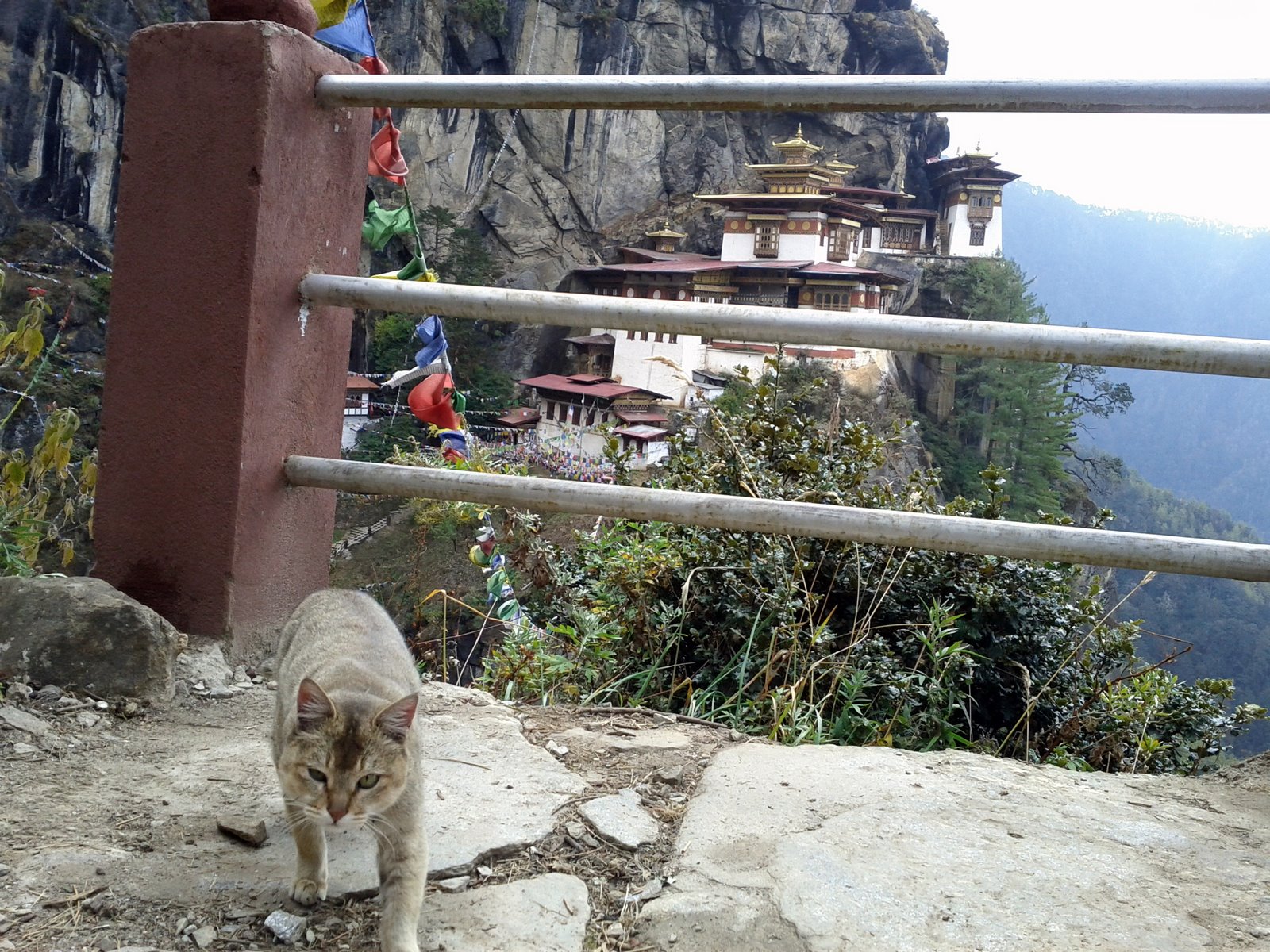
And today, we went to Taktsang, the Tiger's Nest, the coolest monastery ever. Halfway-around-the-world mission accomplished!


It's a hike to get there, about 2-3 hours and 2400 feet uphill. In a land that costs $200/day, there are still a handful of tourists flocking to this Tiger's Nest, but they are all older and richer than I, so I savored for once being the fittest guy on the trail. Well, besides R.K., of course, who set a blazing pace. Anyway, enough talk, more photos.

R.K. and me

Guru Rinpoche (aka Padmasambhava) flew to the cave at Taktsang on the back of a tiger, hence the name. Here, a descendant of that tiger?


I'm in Thimphu now, the capital and biggest city, with 200,000 people. ("2 million", in Bhutanese terms. Bhutanese "million" = Indian lakh = 100,000) It's thoroughly pleasant! The buildings all look super nice, in a traditional Bhutanese way. It's clean. The only ugly things are international, like the few gas stations. Bhutanese speak excellent English. And, importantly, coffeeshops abound. Sadly, I won't have a chance to settle in and hang out here, because being in Bhutan is more expensive than a 24/7 Thai massage.


Nepali food


... is great. I was surprised; I didn't know there was much to it. It's often sold as "daal bhat", which means you get rice and some stuff, like an Indian thali. That "stuff" can just be some spinach, some dal, and some vegetable curry, but that "stuff" can also be quite complex:

- Alu tusi achaar, a "salad" that looked to me more like potatoes and cucumbers in a yogurt sauce. I love yogurt sauces.
- Alu chhwon, a soupy thing with potatoes
- Gundruk achaar, a fermented spinach pickle
- Sandeko, a generic term that means something like "spicy", so you could get "bhatmas sandeko" (spicy beans), or chickpeas or potatoes or meat
- Dhindo/Dhedo, a buckwheat paste/dough that replaces your rice, looks like hell, and tastes great.

I think the first couple dishes are more Newari style, the last couple more Thakali style, where I think Newari and Thakali are popular sub-regions of Nepali food. Anyway, it all tends to be spicy, sometimes sour, and generally healthy tasting. I very much want to make some of it.

A personal connection is worth a lot


Couchsurfing is occasionally a little awkward, occasionally frustrating, but often it opens doors you couldn't find otherwise.

A guy named Kamal messaged me out of the blue when he saw that I'd logged in from Nepal. He offered to meet me and show me the orphanage that he started. A couple other guys had made similar offers, but he seemed the most reasonable.

Aside: there's this weird phenomenon where people from other countries just... do the internet differently. I mean, my friend Flora borrowed my computer to log in to Facebook, and when she went to Facebook, of course I was already logged in, and the first thing on my news feed was a post from an Indian guy I'd met once: a fashion photo of a guy in his underwear. I mean, okay. Or another guy I met once posted on my wall a series of photos entitled "LIVE LIKE A LEGEND AND DIE LIKE A WARRIOR". This isn't even a language barrier issue, it's just... y'know, lengthy disclaimer about cultural relativism and all, but some people do the internet wrong.

Anyway, Kamal seemed like a good guy, and so Flora and I met up with him, and made a plan to see his orphanage later that day. We took a taxi to the outskirts of town, then took his motorcycle from there (3 on a motorcycle is illegal within the city). We ended up at a big manor-like house in a quite pretty suburbanish setting.

The only photo I thought to take before it got dark

It's a nice house, but just big enough for hostel-dorm-style bunkbed housing for the 35 kids who live there. There's an outdoor picnic table area for eating and studying, a kitchen, a couple extra rooms for Kamal and his wife, an office, and a room for volunteers. It's a squeeze, but it fits. Kamal explained that they had only 22 kids, but then his brother (who was also running an orphanage) died, and his orphanage's 13 kids had nowhere to go, so Kamal took them on too.

Worse, their place is a year into a non-extendable 3-year lease. After that, Kamal shrugged, they have to move. (y'know, to another 35-person house.) Furthermore, the kids are each supported by $250/year donors, but as they enter college, costs go way up. So of course they're raising money for everything: money for the kids who are going to college, money for general day to day expenses, and $75k for a permanent building. They're selling personalized bricks at $75 each to donors, which seems like not a bad plan.

So, okay, so I met them. And of course I'd like to do something. I don't know what, right now, so it's a little confusing. But making this connection is a start, I think. Now, if I want to go volunteer in a Nepali orphanage for a day/week/month sometime, I can call them up. If I have a few extra bucks, I can buy a brick. If I want to organize a drive for donations, I know exactly where the money would be going, instead of throwing cash at a big organization.

Furthermore, if you want to do any of these things, well, now you can too. You and I both have a connection to an organization that's not big and bureaucratic, and not actually some scam by a shady guy in a back alley. It's a start.

Oh, and here they are.